


AMBENO (TOP) - A joint venture between Finder Energy and the state oil company TIMOR GAP, E.P. is preparing to develop the Kuda Tasi and Jahal (KTJ) offshore oil fields near Timor-Leste. It would be the first new offshore oil development since the country’s main producing field closed. The partners aim to produce first oil in early 2028.
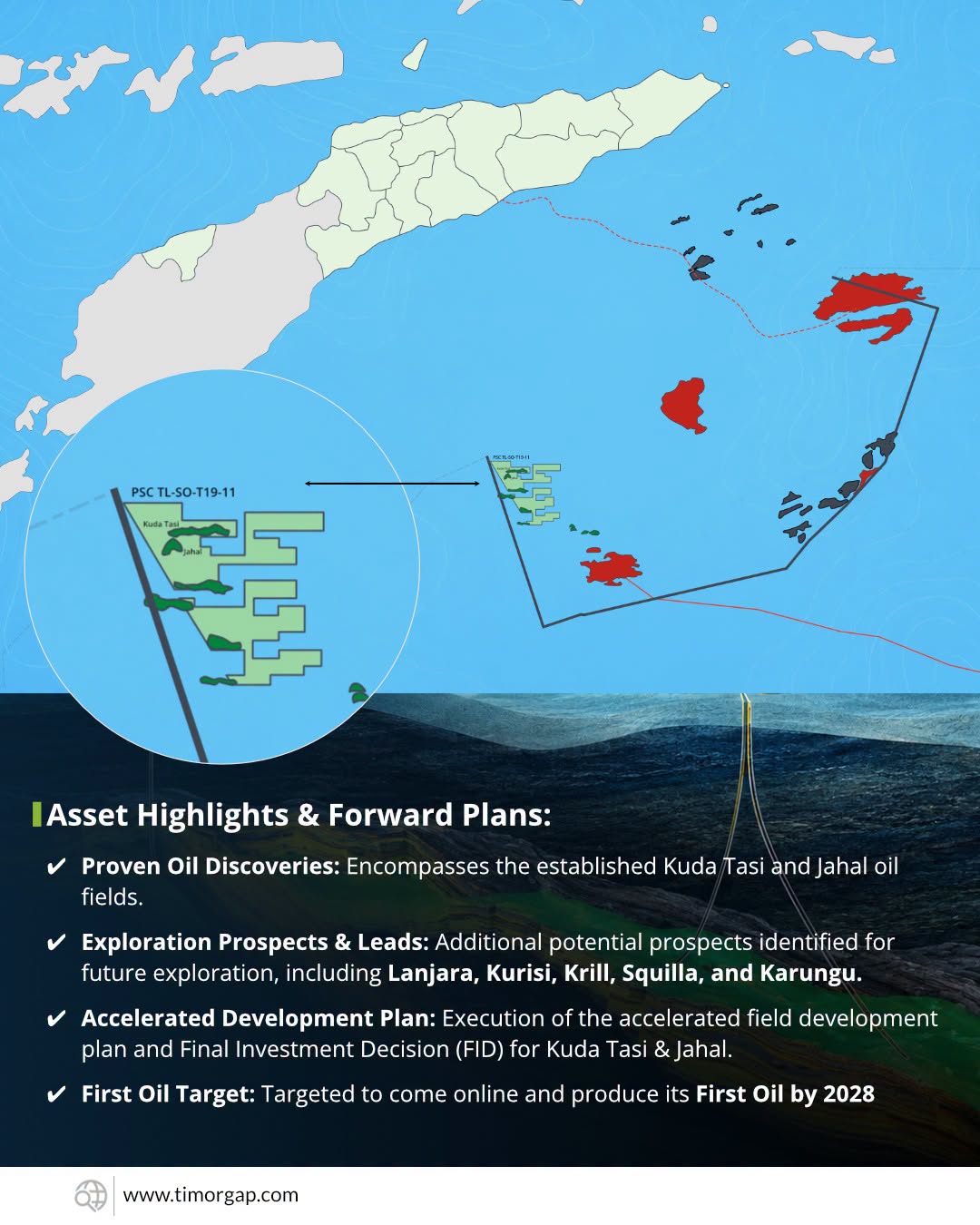
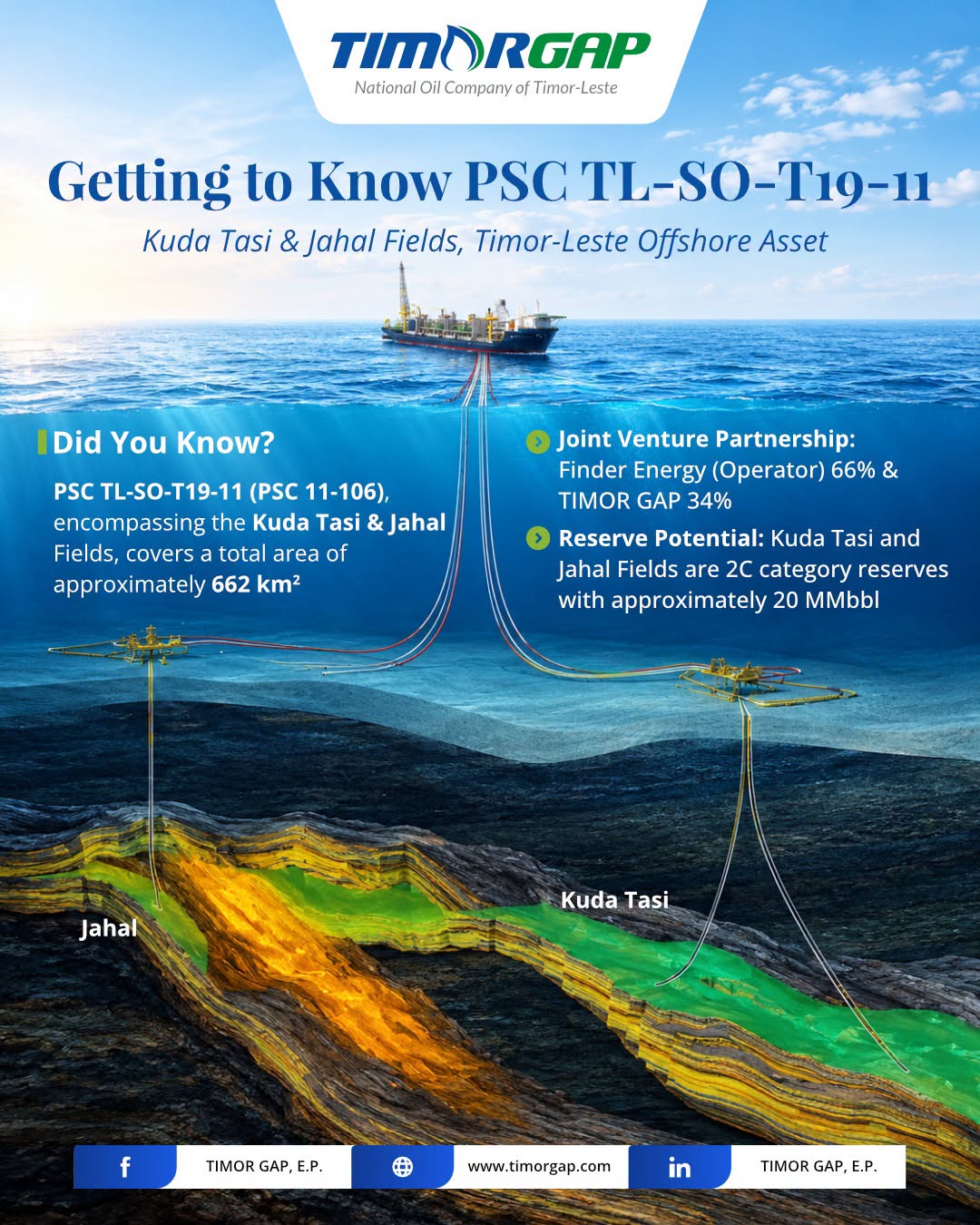
The two fields lie in the Timor-Leste Exclusive Area (TLEA) under Production Sharing Contract PSC-TL-SO-T 19-11, which covers about 662 square kilometres. Finder Energy holds 66 per cent and is the operator. TIMOR GAP holds 34 per cent. The contract also includes other discoveries and prospects, including Krill and Squilla.
The KTJ news comes as the country’s leaders focus on a much larger project. President José Ramos-Horta told ABC News in Sydney that the long-stalled Greater Sunrise gas project is “finally happening” after years of deadlock, according to an ABC report published on 18 October.
He said Prime Minister Xanana Gusmão believes three key documents will be finalised and agreements signed within months. Formal approval is expected early next year, after the two governments and Woodside complete their reviews. Woodside holds a third of the project. He also said Woodside remains committed to the plan to pipe the gas to Timor-Leste.
The urgency is financial. The country depends heavily on oil and gas revenue from past years invested in the Petroleum Fund. In 2022, Ramos-Horta warned Timor-Leste would face a “fiscal cliff” if Greater Sunrise did not start producing within ten years. The IMF has warned the fund could run out by 2038. KTJ is another, much smaller project, but both are part of the same effort to replace falling petroleum revenue.
Kuda Tasi is not a new discovery. The field was found in 1998 through exploration drilling by ConocoPhillips and its partners, and it went undeveloped for more than a decade.
The project moved quickly in 2025 and 2026. TIMOR GAP raised its stake in the joint venture by ten percentage points to 34 per cent through a farm-in agreement with Finder. Under the deal, TIMOR GAP pays 50 per cent of development capital costs, up to a gross cap of US$338 million. Finder says the remainder will be financed with debt.
In July 2026, the regulator, the National Petroleum Authority (ANP), approved the Field Development Plan, clearing the way for the joint venture to move toward a Final Investment Decision (FID). Phase 1 is designed around a reused floating production, storage and offloading vessel (FPSO), the Petrojarl I, three production wells (two at Kuda Tasi and one at Jahal), and a subsea production system. In October, Finder signed a contract worth an estimated US$42.3 million with Eneos Drilling for the Hakuryu-5 rig to drill the three development wells.
FID, the point at which the partners commit capital, has not yet happened. The farm-in agreement required FID before 30 September 2026, and that condition has been extended to 30 November 2026. Finder says it and TIMOR GAP are working on the remaining activities, including the main contracts and the transition to project execution.
The schedule has also slipped. Earlier company materials targeted FID in May 2026 and first oil at the end of 2027. The target is now early 2028, depending on completion of the development programme and the related investment decision.
The fields are classified as 2C contingent resources, with about 20 million barrels (MMbbl) as an estimate. Contingent resources are volumes that may be recoverable but are not yet commercially confirmed, and they are not proven reserves. Other figures exist. An earlier estimate put contingent resources at 22 million barrels. An independent audit by RISC Advisory put Finder’s net entitlement at 14.4 MMstb of 2P reserves, or 15.8 MMstb counting 2P together with 2C.
Finder’s reservoir modelling forecasts initial production rates of 25,000 to 40,000 barrels per day. The Petrojarl I FPSO has processing capacity of 25,000 to 30,000 barrels per day, which is the technical ceiling on initial output. Finder also projects the two fields could produce 10 million barrels in the first 18 months. These figures come from the company’s own modelling, not independent verification, and output is expected to decline as the field ages.
In June 2025, Finder said that at an oil price of US$75 a barrel, the first 18 months of production could generate about US$750 million in revenue. A TIMOR GAP vice-president said a barrel currently trades between US$75 and US$80. But the US$750 million is gross revenue from oil sales. Operating costs, taxes, royalties and production sharing have not been deducted, and TIMOR GAP’s 34 per cent share must also pay its share of development costs. The fiscal terms of PSC 19-11 do not appear in the public documents consulted by The Oekusi Post, so it is not yet possible to say how much Timor-Leste will receive.
For two decades, Timor-Leste has relied on a single source of revenue. Since independence in 2002, the state has financed itself mainly from the Bayu-Undan gas field. Bayu-Undan stopped producing in June 2025. Timor-Leste keeps its petroleum revenue in a sovereign fund modelled on Norway’s, the Petroleum Fund.
That fund now underpins the state budget. The Petroleum Fund stood at US$18.6 billion in December 2025, but petroleum revenue fell to just US$36 million in 2025 after Bayu-Undan closed. By the end of the first quarter of 2026 the balance had fallen to US$18.31 billion, according to the Central Bank. Withdrawals from the fund finance about 86 per cent of budget revenue, according to Coface’s country risk assessment. The Lowy Institute argued in March 2026 that the fund looks healthy on paper, but the country is drawing it down faster than its capacity allows.
KTJ will not replace that revenue. But it will be the first new oil production under Timor-Leste’s own sovereign petroleum regime. Finder says KTJ is expected to be the first offshore oil asset developed under that regime.
The joint venture has also identified several exploration prospects: Lanjara, Kurisi, Karungu and others. Prospects are geological targets, not discoveries, and require drilling to determine whether oil is present. Seismic data reprocessed from the Krill and Squilla discoveries will be used to assess a possible second phase of development tied to KTJ infrastructure.
TIMOR GAP says the project advances the national petroleum sector and commits to responsible development, stronger national participation and long-term value for Timor-Leste. Some analysts urge caution. A StratSea analysis of Greater Sunrise says TIMOR GAP has no balance sheet independent of the Petroleum Fund, so its stake in these projects is effectively financed with public money. That applies to KTJ too, and raises the question of how much public money is at risk on a field of modest size and uncertain returns. Another question is how much the state will receive from the gross revenue Finder estimates, since the PSC’s fiscal terms are not yet public.