


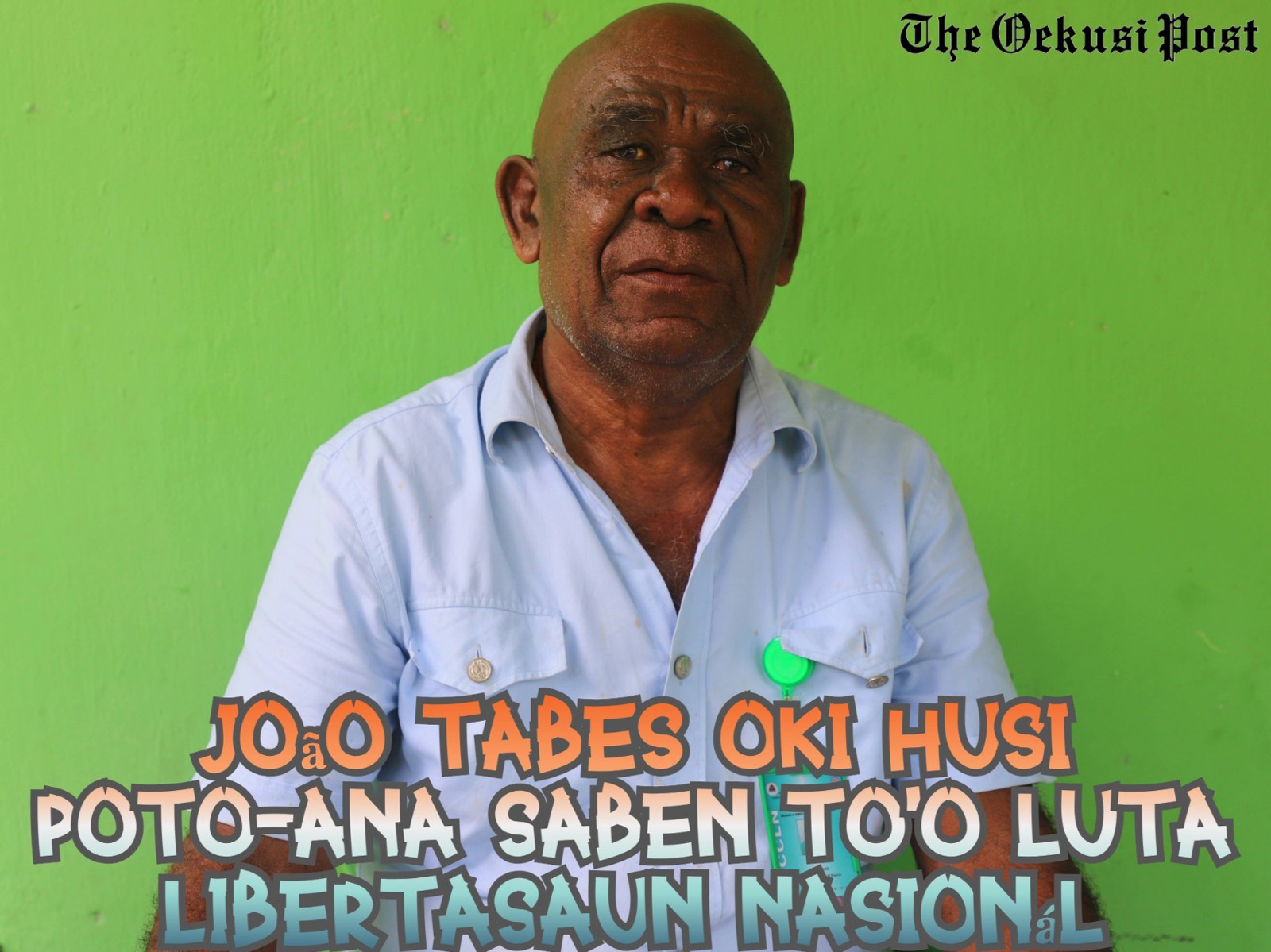
AMBENO (TOP) - The Oe-Cusse Ambeno veteran died at the Guido Valadares National Hospital (HNGV) at age 73. From 1975 to 1999, he walked from village to village campaigning for self-determination, and he never fled as a refugee to Indonesia.
On Wednesday, 7 October 2026, João Tabes Oki, known to the Ambeno people as "Boenbuaf," breathed his last at the HNGV in Dili. He was 73.
For many people in Oe-Cusse Ambeno, his passing is not the loss of just one person. He was a nationalist and a veteran who devoted his whole life to the national liberation struggle from 1975 to 1999.
A nationalist is someone who believes in and supports nationalism, the idea that a nation has the right to maintain its own identity, sovereignty and interests, and that loyalty to the nation matters above all. The core idea is that a people has the right to govern itself, not to be governed by others or by a foreign power. A veteran, meanwhile, is someone who once took part in a war, an armed force or a struggle, and is now recognized for that service or sacrifice.
The late João Tabes Oki “Boenbuaf” was both.
The Ambeno people, who today live in 20 sucos, are living witnesses to his dedication. They describe him as kind, intelligent, disciplined, calm and a man of high integrity. During the Indonesian occupation, he was the figure who never feared campaigning for independence across the whole of Ambeno.
The Fifth Child of the Boenbuaf Clan
João Tabes was born on 18 May 1953 in Bairro Poto Ana, Aldeia Saben, Suco Bobometo, Oe-Silo Sub-district, under the given name Alef Tabes. He was the fifth child of Tabes Ase (António Ase) and Tnepo Neno (Isabel Neno), of the Boenbuaf clan.
Of the nine children in the family, he alone had the chance to go to school. The others became subsistence farmers. The nine children were:
- Mateus Tabes
- Miquel Tabes
- Lourença Tabes (deceased)
- Oracio Tabes (Martyr, also known as Taul Tabes)
- João Tabes “Boenbuaf”
- José Tabes
- Sebastiao Tabes
- Camilio Tabes
- Jorge Tabes
He began pre-primary school in Oe-Silo in 1969. On 1 October 1971, before finishing Fourth Grade, he got the chance to work under the Portuguese as a Maritime Surveillance Police officer. He was posted to Noemeto-Sacato, near the Wini border with Indonesian West Timor, until 1973, and then transferred to Padiae. In Padiae he used his free time to keep studying, and he finished Fourth Grade at Igreja Mean, Hu’e-Knutu, in 1974.
After that, he entered a public competition and won the position of School Monitor (Monitor Escolar). He left police work to teach for three months in Ulas, Suco Taiboko. When Jaime dos Remedios de Oliveira was appointed Portuguese Administrator of Oe-Cusse Ambeno, he called João Tabes to work as a clerk (escriturária, a public servant) in the administration, until the Carnation Revolution in Lisbon on 25 April 1974.
The Struggle Against Obscurantism
“The struggle against obscurantism,” or the struggle against darkness, is an ideological, political and educational concept that means confronting ignorance, lack of knowledge, the manipulation of information and anti-intellectual thinking. The word comes from the Latin obscurare (to darken), and it points to a people or society kept far from the light of knowledge.
In the time of the struggle and at the beginning of the national liberation movement (after 25 April 1974), Timorese leaders and students at the Casa dos Timores, such as Mau Lear, Sahe and Hata, used the expression as a banner of education. They saw the “struggle against obscurantism” as a great challenge: to wipe out the illiteracy the Portuguese colonial regime left behind, and to bring light to the Maubere People through literacy campaigns and political awareness.
The late João Tabes Oki “Boenbuaf” had been involved in this struggle since 1973–1974, working out how to bring light to the Ambeno people. His concrete involvement was as a School Monitor, teaching in Ulas, Taiboko, before he worked as a clerk under the Portuguese Administrator of Oe-Cusse Ambeno, Jaime Oliveira, in 1974.
He did not stop there. Having gone to live in Oe-Sono, Oe-Cusse Ambeno, in the 1970s, he used his monthly salary from the Maritime Surveillance Police to help many Ambeno youths, especially from the Oe-Silo side (Oebaha), gain access to education. He offered not only financial support but also strong motivation for education.
During the political campaign for independence in Ambeno, he always urged parents to send their children to school. When the country received the light of independence, he said, it would need many educated people in many fields to develop the nation.
Breaking the Chain of Oppression by the Liurai System
In the history of Oe-Cusse Ambeno, the alliance between the liurai (traditional rulers) and the Portuguese colonialists became the fundamental basis for forming the enclave’s political identity, and ultimately made the region inseparable from the territory of Timor-Leste.
Oe-Cusse Ambeno, especially Lifau, was the first place where Dominican missionaries and Portuguese navigators arrived and established themselves, in 1556. There, the Portuguese did not immediately subdue the liurai by war. Instead, they made strategic alliances, including marriages, with the local liurai. These alliances were built through commercial exchange (the sandalwood trade), traditional law (tesi-lia), and the Catholic religion, which became a great knot strengthening relations between the two sides.
There were the Kingdom of Oe-Cusse (centered in Oe-Sono) and the Kingdom of Ambeno (centered in Tulaica and Nunu-Henu). When the Portuguese established their colonial administration, they merged these two kingdoms into a single territorial entity named Oe-Cusse Ambeno.
The power alliance between the liurai and the Portuguese colonizers also brought heavy pressure on the Ambeno people. Every citizen approaching the age of 18 had to pay a tax. At every harvest, farmers had to deliver their agricultural products to the liurai for food and drink, as well as candles, traditional cotton cloth and other things. This traditional system of rule was deeply oppressive.
After the alliance was formed, the two great powers divided up a calendar so that every night they made visits to communities in various places. On these night visits they held briefings on government affairs, and when it was time to rest, the communities had to prepare a woman (feto-ran) for the liurai to keep him company for the whole night.
The late João Tabes Oki “Boenbuaf” began to rise up to oppose and tear down this system of rule. He had been a member of the Maritime Surveillance Police since 1971. Between 1973 and 1974, when he returned from his police command at Hu’e-Knutu, Padiae, to Biseon, near the Roti area, he happened upon the liurai of Oe-Cusse Ambeno together with the Portuguese colonialists, making a night visit there.
He had a chair in his house. When he arrived, he could no longer find it. He asked his family who had taken the chair. They answered that the liurai had visited that night, and that the chair had been carried off for the liurai and his guests to sit on. He stormed to the place where the liurai was visiting and shouted loudly, asking who had taken his chair. The liurai stood up to hit him, but João Tabes struck him at once, and the night visit collapsed.
From that incident, he began moving through many places in Ambeno, campaigning and spreading the message that people must now stand up and fight against the liurai who were working with the Portuguese colonialists to destroy their cultural identity.
He fought this behavior not only in Biseon but in many other places. Nearly all the generations of the Ambeno liurai were beaten by him, from the Portuguese era to the Indonesian era. Those liurai generations who felt his blows have long since gone to the other world, and now he too is following them.
FRETILIN and the Campaign Across 18 Sucos
In 1975, João Tabes joined FRETILIN and was made responsible for producing the party’s membership cards.
In March 1975, FRETILIN President Francisco Xavier do Amaral visited Oe-Cusse Ambeno to campaign for mobilization and political awareness. João Tabes and his comrades received him at Palaban airport and invited him to campaign at the old Sta. Rosa market, which is now the site of the SEPFOPE RAEOA building. He was also involved in a protest under the slogan: “Integração – nunca, nunca e nunca, o Povo está com a FRETILIN.”
After the President returned to Dili, João Tabes, a former Maritime Surveillance policeman on good terms with Administrator Jaime dos Remedios de Oliveira, led the outreach and campaign across 18 sucos of Oe-Cusse Ambeno. He started from Sacato and continued to a sacred house in the highlands of Noke, escorted by three policemen: Arthur da Cruz, Crispiano do Amaral (from Likisa) and Manuel Soares (from Numbei).
Suffering During the Occupation
After Indonesia invaded Timor-Leste on 7 December 1975, João Tabes was held in preventive detention from 1 July 1976 to 31 December 1978. A second period of preventive detention began on 6 January 1998.
Even so, he never fled to Indonesia. From the invasion to the 1999 Popular Consultation, he held firm to the soil of the enclave of Oe-Cusse Ambeno.
His suffering did not end after the Popular Consultation. He lost his own brother, Taul Tabes, who was beheaded by a pro-Indonesian militia in Oebaha in 1999.
It is true that the Ambeno people did not take up weapons to mount an armed resistance against the Indonesian occupation of Timor-Leste. But the people of this enclave resisted at the very doorstep of the enemy, from 1975 to 1999. To justify this claim, let us look closely and listen again to the late João Tabes Oki, alias “Boenbuaf,” and his participation in the struggle for national liberation.
Participation in the National Liberation Struggle
His participation in the national liberation struggle was as follows:
- FRETILIN activist from 20 August 1975 to 31 March 1984.
- After Indonesia invaded Timor-Leste on 7 December 1975, held in preventive detention from 1 July 1976 to 31 December 1978. A second period of preventive detention occurred on 6 January 1998.
- Boxer in 1978. From this boxing career he took the name “Bulldozer,” which he used to push away the pro-integrationists who kept the enclave of Ambeno from being at peace.
- CRRN activist, 1 April 1984 – 31 December 1986.
- CNRM activist, 1 January 1987 – 31 December 1992.
- Zone Secretary in Fitun Mutin A (Pantai Macassar A), Oe-Cusse Ambeno, 1 January 1993 – 14 September 1998.
- Head of a demonstration committee against the Indonesian military in Oe-Cusse Ambeno in 1996.
- With the HAKSOLOK Sub-region team of 14 people, took part in a meeting at Fatubesi, Ermera, in 1997.
- With Vital das Neves, represented Oe-Cusse Ambeno at a cultural meeting in Letefoho, Ermera, in 1997. At this meeting, Indonesian military forces attacked, and he managed to flee Letefoho and reach Dili in the dead of night.
- Led the campaign of the Dewan Solidaritas Pemuda Pelajar Timor-Leste (DSMPPTL) in Oe-Cusse Ambeno from 1997 to 1998.
- August 1999: Head of the Organizing Committee and Pro-Independence Campaign for the Referendum, from 14 to 27 August 1999, in the HAKSOLOK Sub-Region, Oe-Cusse Ambeno.
For these dedications, the State of Timor-Leste recognized his participation in the struggle for national liberation with the Order of Nicolau Lobato.
“Enak Aja”
In the independence era, João Tabes created a new code name: “Enak Aja.” The name was a sarcastic jab at those who once did not want independence but today live comfortably in the independence era.
Cultural and Historical Facts
Cultural history makes it clear that the grandparents of the late João Tabes Oki “Boenbuaf” were, from long ago, the guardians of the Oe-Cusse Ambeno border. From Bilu Banteta, Banila (Paut) and Oebaha, the guardians were Tabes Neno (Teut Oki) and Nabu Ole. Afterwards, Ili Bobo (Ili Ana) went on to guard another stretch of the Ambeno border at Noemuti, up to the border between Oe-Silo (Poto) and Napan, TTU, Indonesia, as Neus-Matani, Eon-Matani, Neus-Mese Bitimo and Eon-Mese Bitimo.
João Tabes Oki “Boenbuaf,” like his grandparents before him, was a very strong nationalist who defended and protected the border of the enclave of Ambeno from generation to generation, up to today.
João Tabes Oki was not a liurai in Ambeno Oe-Cusse, but he was no traitor to the Fatherland. He was a nationalist and a veteran in the enclave of Oe-Cusse Ambeno.
The Independence Era
In the era of independence, he continued to show his full dedication by taking part in the national development process, serving as a civil servant in the administration of the Government of Timor-Leste. He became a figure of reconciliation between pro-independence and pro-integration Timorese, and he always encouraged parents to send their children to school so they could develop the country, following the dreams and wishes of all the martyrs: that this land must be freed from illegal occupation, and that the people must be freed from all forms of torture so they can have a good and dignified life.
Inspiration
The enclave of Oe-Cusse Ambeno, geographically surrounded by Indonesian territory and lying within Indonesia’s own enclosure, required someone with courage to resist in whatever form possible. The late João Tabes Oki, alias Boenbuaf, was a very brave man. He never took a step backward in resisting the Indonesian occupation of Timor-Leste, especially in Oe-Cusse Ambeno. All clandestine activities and movements in the enclave of Ambeno were always led by him, and some situations that seemed impossible to handle, he made possible.
His courage became an inspiration to the Ambeno people, village by village, to become more deeply involved in the clandestine struggle. The proof is in the result of the Popular Consultation, in which Oe-Cusse Ambeno placed first in the national territory with 78% in 1999.
Legacy
João Tabes leaves behind his wife, Demetria Oqui, and four children: Maria Florentina Oqui, Izabel Florentina Oqui, Josefina Florentina Oqui and Paulo Octo de Jesus Oqui.
Physically, he is no longer with the people of this world. But his thinking, intelligence, dedication and spirit of credibility continue to live in the hearts of the Ambeno people, and remain a reference for the younger generation to continue his steps and carry this country forward.
His family, in deep sorrow, will lay the late João Tabes to rest at the Sta. Rosa public cemetery in Oe-Cusse Ambeno on Saturday, 10 October 2026, at 4 p.m.
Requiescat in Pace